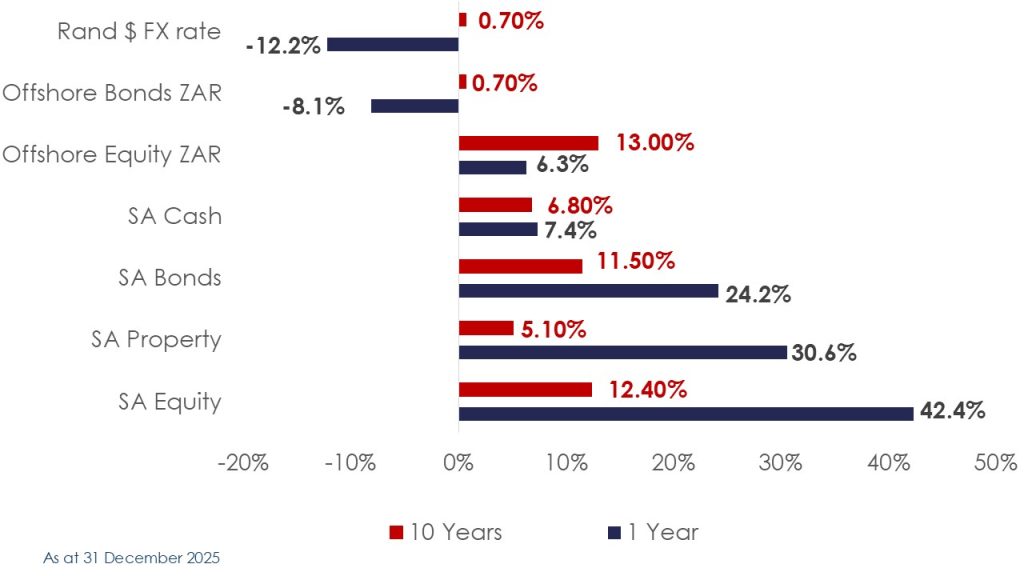
2025 was a great example of why, as a South African, you should never have 100% of your investments offshore.
It was a sensational year for local assets, while the double digit appreciation of the Rand (ZAR) versus the US Dollar (USD) reduced returns from locally held offshore investments.
You may remember
If you were one of those South African’s reading Magnus Heystek’s sell everything, pay the tax and go 100% offshore a few years ago, this would be a good opportunity to recognise the value in a more balanced approach.
When you live in SA and the majority of your costs (liabilities) are in SA, you cannot afford to have all your money offshore for this exact reason.
I would go one step further. Mentally store this information for the next time someone urges you to go 100% offshore. (there will be a next time)
Even just one year ago it was easier to believe the Rand would trade at 25 to the US Dollar than to think 15 was possible…… how things change.
The past returns of an asset are the returns you are not going to enjoy.
A comparison between the 1 year returns and the average return over the last 10 years, can provide some insight.
The real question remains what comes next?
Asset Class Returns – 1 & 10 Years to end December 2025
Looking at average returns over longer time periods suggest that returns over the next few years will probably not match 2025.
This is not the same as saying 2026 will see a major sell-off.
Fact is:
– Strong recent performance makes assets more expensive. – Future returns are determined by the price you pay for the assets you own. – Ergo periods of sustained strong performance are likely to be followed by more tepid returns.
You know what helps
Managing your expectations around returns and accepting that occasional sell-offs or downturns are what inevitably bring us closer to long-term average returns over time is important.
Sell-off’s are a feature of investing, not a bug that can be fixed or avoided altogether.
Matching your investment strategy to what you are trying to achieve, knowing you can’t predict future returns is why you build a diversified portfolio.
100% Offshore is never the right option if you are looking at your overall financial position.
Used to monitor number of Google Analytics server requests when using Google Tag Manager
1 minute
_ga_
ID used to identify users
2 years
_gid
ID used to identify users for 24 hours after last activity
24 hours
_gali
Used by Google Analytics to determine which links on a page are being clicked
30 seconds
__utmx
Used to determine whether a user is included in an A / B or Multivariate test.
18 months
_ga
ID used to identify users
2 years
__utmv
Contains custom information set by the web developer via the _setCustomVar method in Google Analytics. This cookie is updated every time new data is sent to the Google Analytics server.
2 years after last activity
__utmb
Used to distinguish new sessions and visits. This cookie is set when the GA.js javascript library is loaded and there is no existing __utmb cookie. The cookie is updated every time data is sent to the Google Analytics server.
30 minutes after last activity
__utmc
Used only with old Urchin versions of Google Analytics and not with GA.js. Was used to distinguish between new sessions and visits at the end of a session.
End of session (browser)
__utmz
Contains information about the traffic source or campaign that directed user to the website. The cookie is set when the GA.js javascript is loaded and updated when data is sent to the Google Anaytics server
6 months after last activity
__utma
ID used to identify users and sessions
2 years after last activity
__utmt
Used to monitor number of Google Analytics server requests
10 minutes
_gac_
Contains information related to marketing campaigns of the user. These are shared with Google AdWords / Google Ads when the Google Ads and Google Analytics accounts are linked together.

0 comments