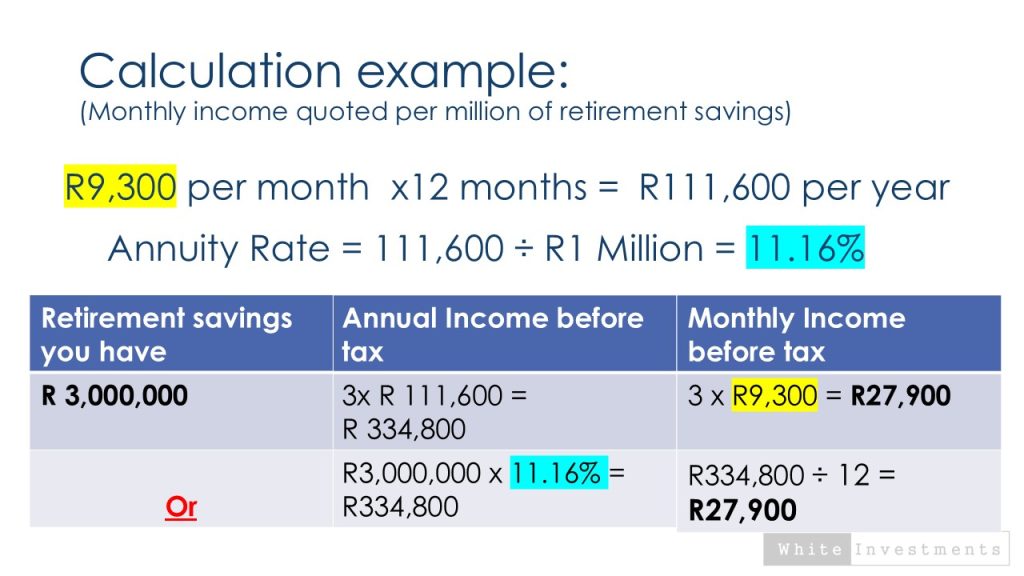
How you can work out your income from a life annuity quote.
Where you can get an idea of current life annuity rates updated weekly.
Buying a life annuity is a permanent decision for you.
A Life Annuity is also called a Guaranteed Annuity.
What is a Life Annuity?
If you are saving for retirement or nearing retirement you will at some point need to make an annuity decision.
An annuity is what you need to purchase with at least two-thirds of your retirement funds at retirement.
You effectively exchange your lumpsum retirement savings for a stream of future income payments, designed to replace your salary.
And just like your salary, this income is taxed according to your individual income tax tables.
Who provides a Life Annuity?
Life companies provide annuities – they are essentially an insurance contract.
When you are nearing retirement, you will go out to Life companies or your advisor and ask them to ‘quote’ on an annuity income.
This ‘quote’ option is relevant only to a Life or Guaranteed annuity.
Usually the quote is valid for a week.
How does a Life or Guaranteed Annuity work?
When you buy a Guaranteed annuity you agree the income, and how that income may change over time, at the outset. It is a contract.
The insurer commits to paying that income on those terms for the remainder of your life. Your decision once agreed is irreversible.
The request to ‘quote’ is transactional. On its own it does not address your personal needs and has no link to planning for your life.
Usually the quote is valid for a week.
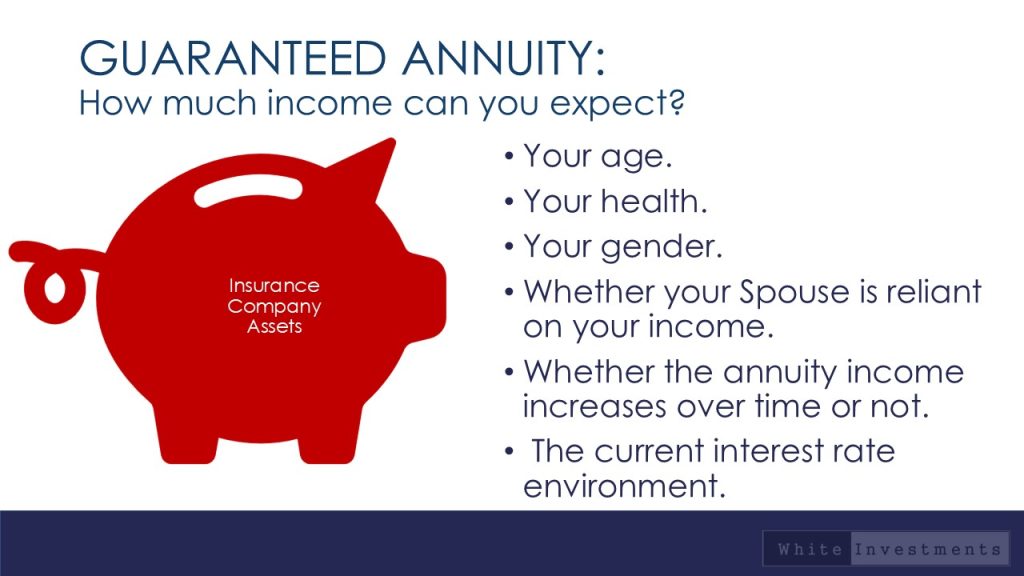
What impacts the annuity rate you are offered?
The more risk the insurance provider takes on the less you will get ‘quoted’ or offered upfront.
By risk I mean how much they expect that they will have to pay you over your lifetime.
The younger you are, the longer they will have to make payments. So expect a lower starting income.
If you are healthy, a non-smoker with no history of illness, the probability is they will need to pay you for longer. You will be offered a lower starting income
Woman have a longer life expectancy than men. That means longer payment periods for the insurer and…. you guessed it, a lower starting income.
Do you need the payment to be made to your spouse if anything happens to you? Yes? They cover two lives, so they expect to make payments for longer and the lower your starting income offer.
Do you want your income to increase over time to keep up with the rising cost of living? This means higher payments for them over time and a lower starting income.
You get the idea.
The ‘quote’ you receive will be determined by many factors.
Where can you see published annuity rates?
You can check the annuity rates weekly from a broad list of providers as below:
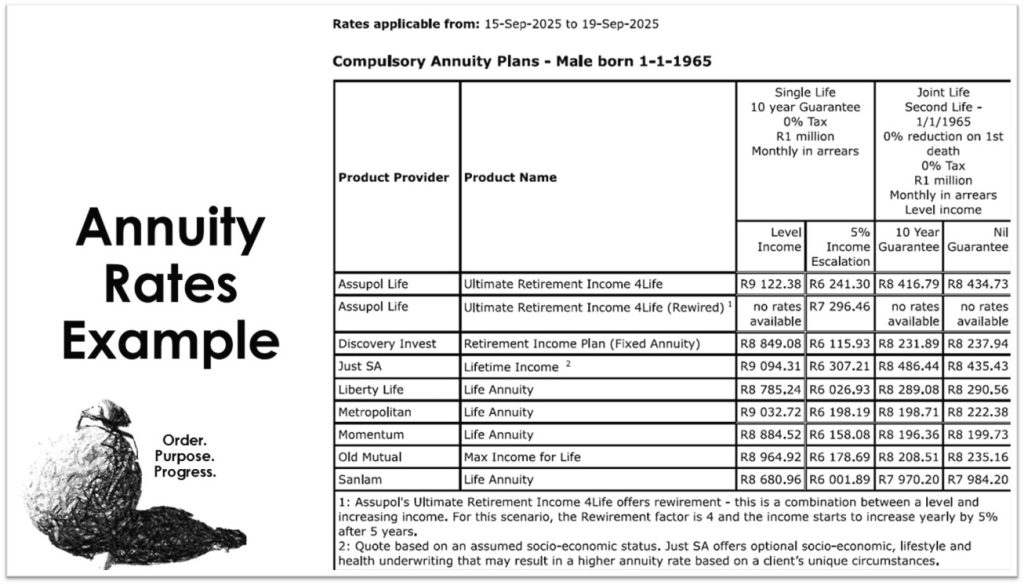
This table shows the rates for a 60 year old male, single life or joint Life (includes Spouse at 100% income). It shows a level income (does not change over time) and one that goes up by 5% a year. You can get a minimum guarantee period or not.
You would choose an annuity that best suits your own needs and use the corresponding Rand value to indicate the monthly income you will receive per R1 million that you exchange for it.
Using this calculation method at your chosen Rand annuity amount, will give you an idea of how much income you can expect.
This could then be compared to your current income to see what proportion of your current income your retirement income will cover.
This is called your Net Replacement Ratio.

What to keep in mind when considering Guaranteed or Life annuities
The terms are set for life they cannot be changed.
Your income ends with you (or spouse if joint life).
Nothing passes on to other beneficiaries.
A higher starting level income is attractive. It will take about 7 years before it equals an escalating annuity that increases at 5% per year. Thereafter you will see a steady fall in how much you can purchase with the same level income.
Bottom Line
The right annuity for you needs to be more than just a quote – It should be a well thought out decision based on your personal needs and understanding of the risks and trade-offs involved.
It is not the time to be rushing decisions or risk making costly mistakes.
Used to monitor number of Google Analytics server requests when using Google Tag Manager
1 minute
_ga_
ID used to identify users
2 years
_gid
ID used to identify users for 24 hours after last activity
24 hours
_gali
Used by Google Analytics to determine which links on a page are being clicked
30 seconds
__utmx
Used to determine whether a user is included in an A / B or Multivariate test.
18 months
_ga
ID used to identify users
2 years
__utmv
Contains custom information set by the web developer via the _setCustomVar method in Google Analytics. This cookie is updated every time new data is sent to the Google Analytics server.
2 years after last activity
__utmb
Used to distinguish new sessions and visits. This cookie is set when the GA.js javascript library is loaded and there is no existing __utmb cookie. The cookie is updated every time data is sent to the Google Analytics server.
30 minutes after last activity
__utmc
Used only with old Urchin versions of Google Analytics and not with GA.js. Was used to distinguish between new sessions and visits at the end of a session.
End of session (browser)
__utmz
Contains information about the traffic source or campaign that directed user to the website. The cookie is set when the GA.js javascript is loaded and updated when data is sent to the Google Anaytics server
6 months after last activity
__utma
ID used to identify users and sessions
2 years after last activity
__utmt
Used to monitor number of Google Analytics server requests
10 minutes
_gac_
Contains information related to marketing campaigns of the user. These are shared with Google AdWords / Google Ads when the Google Ads and Google Analytics accounts are linked together.