When you die your retirement savings treatment depends on your actions while you are alive.

Retirement funds usually make up a significant portion of an individual’s net-wealth in South Africa.

By naming beneficiaries on your retirement funds, your retirement assets won’t be dealt with within your deceased estate.

This allows you to:

  • Avoid executors fees on these funds
  • Ensure that the funds become available to your beneficiaries faster than if they went through the deceased estate settlement process.

If you have not made beneficiary nominations on your retirement funds as yet, there is a form and 5 minutes worth spending today. Get hold of your service provider. 

What you need to know

In the event of your death, the treatment of your retirement savings depends on whether you were still saving for retirement (pre-retirement), or if you had already retired and those funds are providing you with an income (post-retirement).

If you die before you retire:

  • You will be invested in what are called pre-retirement funds.
  • These include; Retirement Annuities, Pension, Provident and Preservation Funds.
  • You can and should name beneficiaries on these, but your nomination is a guide, not a certainty.
  • Pension Fund Law requires pension fund trustees to pay out the proceeds to your dependents, people that you support financially. These may be different from those you nominate as beneficiaries on your retirement funds.
  • The Board of Trustees of your retirement fund have 12 months to investigate and make certain of who all your dependents are before paying out.
  • They will decide how to split the proceeds based on their assessment of all dependents needs.

If you die after you have officially retired:

  • You will be invested in post-retirement funds which are either a Living Annuity, a Life/Guaranteed Annuity or some combination of the two.
  • You can and should nominate beneficiaries on your Living Annuity funds.
  • Your Life Annuity is a contract which unless you signed up for a Joint-Life annuity (includes your spouse) or have a guarantee period, your annuity will die with you and there is no beneficiary.
  • Your nomination on your Living Annuity is binding and there is no legal requirement for Trustees to determine whether there are other dependents.  
  • The Trustees will pay to the named beneficiaries in the proportion you determined on your nomination form.
  • This means the payout process should be relatively quick.

What your beneficiaries choose to do is key

Your nominated beneficiaries will receive a formal letter to alert them when the time comes that they are set to receive a payout.

It will likely include only a basic outline of the options they have:

  1. Cash Lump-sum: They can receive the money as a cash lump-sum payment. This is taxable as per the retirement lump-sum withdrawal tax tables published by SARS.
  2. Buy an Annuity: They can use the funds to buy an annuity income stream in their own name. There are two types of annuity income they can purchase; a Living Annuity or a Life/Guaranteed Annuity.

The lump-sum transfer is tax-free if your dependent goes for the annuity option, but the future income streams will be taxed as per their individual income tax tables.

It is possible for them to take a portion as a cash lump-sum and use the rest to buy an annuity.

How you can help your beneficiaries

Your beneficiaries will likely receive very little, if any, detailed insight into what the implications and consequences of their choices are.

Yet each beneficiary will have to make the decision for themselves – You cannot control or elect what they do with the proceeds.

So it falls upon you to make this process more beneficial for them. You can arm them with the knowledge to understand the consequences of their decisions and I would like to help you do that. 

I have created a free guide for you to send on to your beneficiaries to help in this process should the need arise.


FREE GUIDE: The Real consequences of your Retirement Death Benefit decisions.

Valuable insights into the process, their options and examples of how your beneficiary’s decisions play out over time. Don’t waste this great opportunity.  

If you would like to receive this guide, please send me an Email: info@whiteinvestments.co.za with the Subject line: Retirement Beneficiary Guide Request

You can only influence what is in your control

Sharing the guide with your nominated beneficiaries is a good start.

On top of that, make sure you have a file which contains the information available for your beneficiaries to share with the Board of Trustees of your pre-retirement funds.

By providing proof of dependency via a marriage certificate, divorce maintenance order, children’s birth certificates and bank statements, you can help them progress their compulsory investigation as quickly as possible.

It will help to avoid unnecessary delays in your beneficiary payouts.
Read More

Key Take Aways:

  • Choosing how to structure your annuity income is a critical decision.
  • It is not an either or decision between a Life and Living Annuity.
  • You can blend or use a combination of annuities.
  • It would benefit you to understand your annuity options and the implications of your choices.
  • This case study gives you a feel for how it can work for you.

Deciding how to structure and access the best income from your retirement nest egg? 

This analysis on blending annuity incomes is for you.

A Surprising Revelation

For anyone approaching retirement, one question tends to dominate: “Will my money last as long as I do?”

Traditionally your two main options of accessing a regular income in retirement are:

Living Annuity – Offers flexibility and control of your income but carries a higher risk of outliving your savings if you are not careful. You get to leave any remaining capital behind for beneficiaries.

Life (Guaranteed) Annuity – Provides income certainty as the income is guaranteed to be paid for the reminder of your life. The catch is that any unused capital cannot be left for your beneficiaries.

This can turn the decision making into a tug-of-war in your mind: the desire for flexibility and control versus the desire for certainty and a good night’s sleep.

But it does not have to be one over the other.

If you make the decision before retiring from your funds, you can make use of a combination of the two.

You may be pleasantly surprised by the findings.

The Analysis

If we analyze and compare these 3 options using a financial model, we can see exactly where the risks lie and how they can potentially be mitigated.

In the following case study we consider the 3 options:

(1) A 100% Living Annuity (LA)

(2) A 100% Guaranteed or Life Annuity (GA)

(3) A Blend of the two – 40% GA and 60% LA

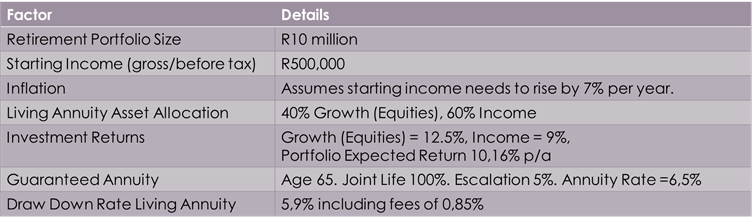
Firstly, as with all models there are some key Assumptions that need to be made. Here is a summary of them:

Assumptions for the blended annuity analysis by White Investments.

Comparison tables of the key findings:

Percentage of required income received

What about how much you can leave behind for beneficiaries

Please note the legacy values expressed above do not take into account inflation (nominal values). The real feel, or purchasing power, of the 20-year capital value,  if inflation was 7%, would be R2.8 million for the 100% LA and R3.6 million for the Blended option.

1. The Flexible Living Annuity can be a longevity trap

The 100% Living Annuity (LA) is attractive because it puts you in control. Your capital remains invested, giving you the potential for inflation-beating growth and the flexibility to adjust your income. However, this control comes with longevity risk, the danger of your money running out before you do.

In a high-inflation environment (modelled here at 7%), this risk is significant. The model shows the pure LA is projected to fully meet your expected income needs for 21 years.

For the first two decades, everything feels fine. After age 85 you reach your maximum LA cap of 17.5% of your portfolio, and your income falls quickly thereafter. By age 90, you are projected to cover only 53% of your income needs.

This is where the initial comfort of a flexible annuity can feel more like a trap, and there is little that can be done about it by that stage.

2. The Guaranteed Annuity’s Hidden Risk: A Fading Income

The 100% Guaranteed Annuity (GA) solves for the longevity risk problem. With this type of annuity you exchange your capital for a predictable income stream you cannot outlive. It is an insurance contract with terms agreed upfront that cannot be changed.

Your capital is no longer yours to manage or leave as a legacy but you do get peace of mind that the payments will never stop while you are alive.

Even if you are not worried about leaving a legacy behind there is still a potential issue for you to consider though. Inflation risk.

When you buy this annuity the agreement will stipulate the income you receive and how that will be adjusted year after year. In this example we selected an annuity which increases by 5% per year.

But since inflation is assumed to be 7%, your income will not keep up with your real world expenses. Also known as a loss of purchasing power.

The model reveals that the GA fails to provide 100% of the required income from age 80 onwards. By age 85, it covers only 88% of your needs. At 90, that falls to 80%, and by age 100, your “guaranteed” income covers just 67% of your lifestyle costs.

You won’t run out of money, but you may run out of your income’s ability to cover your living expenses fully.

3. The Hybrid “Blend”: A superior system

This brings us to the most powerful finding from the analysis.

When you stop seeing this as an “either/or” choice you can potentially build a better solution to solve for both longevity and purchasing power risk.

The model tested a Blended Annuity where 40% of the initial capital (R4 million) was used to purchase a Guaranteed Annuity, with the remaining R6 million invested in a Living Annuity.

The results speak for themselves.

First, the blend provides 100% of the retiree’s required income all the way to age 95, improving on the  GA’s purchasing power problem and the LA’s longevity problem.

And what about your concerns over leaving a legacy behind?

After 30 years of providing an income, the Blended Annuity’s capital had grown to R17.3 million, more than four times the R4.1 million projected to be remaining in the pure Living Annuity portfolio. (As mentioned you do not get to leave any of the GA capital to beneficiaries).

Conclusion:

This analysis shows that an intelligent, blended approach is potentially a superior solution designed to mitigate the primary risks of both standalone strategies.

That could transform everything for you and make your tough decisions easier at this crucial time.

Lets chat if this is something you want to understand and potentially include in your own retirement planning transition.

By the way……. If you are still feeling a little overwhelmed and perhaps have even more questions as you approach retirement? Why not check out my RETIRE READY workshop designed to help you make the best decisions from a position of real knowledge. Find out more here: RETIRE READY  

Read More

Key Takeaways:

  • Characteristics of life annuities. 
  • How you can work out your income from a life annuity quote.
  • Where you can get an idea of current life annuity rates updated weekly. 
  • Buying a life annuity is a permanent decision for you.
  • A Life Annuity is also called a Guaranteed Annuity.

What is a Life Annuity?

If you are saving for retirement or nearing retirement  you will at some point need to make an annuity decision. 

An annuity is what you need to purchase with at least two-thirds of your retirement funds at retirement.

You effectively exchange your lumpsum retirement savings for a stream of future income payments, designed to replace your salary.

And just like your salary, this income is taxed according to your individual income tax tables. 

Who provides a Life Annuity?

Life companies provide annuities – they are essentially an insurance contract.

When you are nearing retirement, you will go out to Life companies or your advisor and ask them to ‘quote’ on an annuity income. 

This ‘quote’ option is relevant only to a Life or Guaranteed annuity.

Usually the quote is valid for a week. 

How does a Life or Guaranteed Annuity work?

When you buy a Guaranteed annuity you agree the income, and how that income may change over time, at the outset. It is a contract.

The insurer commits to paying that income on those terms for the remainder of your life.  Your decision once agreed is irreversible. 

The request to ‘quote’ is transactional. On its own it does not address your personal needs and has no link to planning for your life.

Usually the quote is valid for a week. 

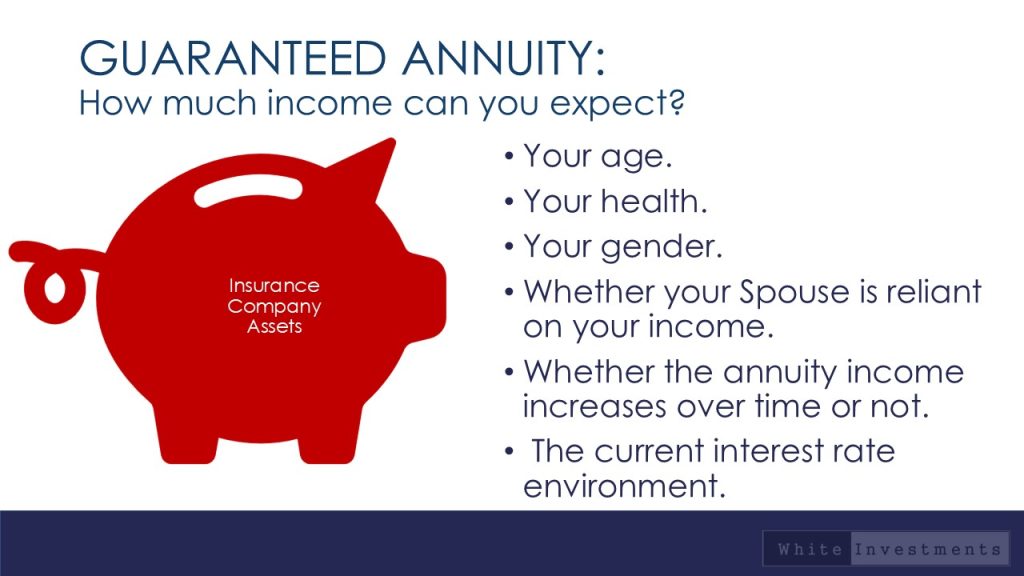
What impacts the annuity rate you are offered?

The more risk the insurance provider takes on the less you will get ‘quoted’ or offered upfront.

By risk I mean how much they expect that they will have to pay you over your lifetime.
 

  • The younger you are, the longer they will have to make payments. So expect a lower starting income.
  • If you are healthy, a non-smoker with no history of illness, the probability is they will need to pay you for longer. You will be offered a lower starting income
  • Woman have a longer life expectancy than men. That means longer payment periods for the insurer and…. you guessed it, a lower starting income.
  • Do you need the payment to be made to your spouse if anything happens to you? Yes? They cover two lives, so they expect to make payments for longer and the lower your starting income offer.
  • Do you want your income to increase over time to keep up with the rising cost of living? This means higher payments for them over time and a lower starting income.

You get the idea.

The ‘quote’ you receive will be determined by many factors. 

Where can you see published annuity rates?

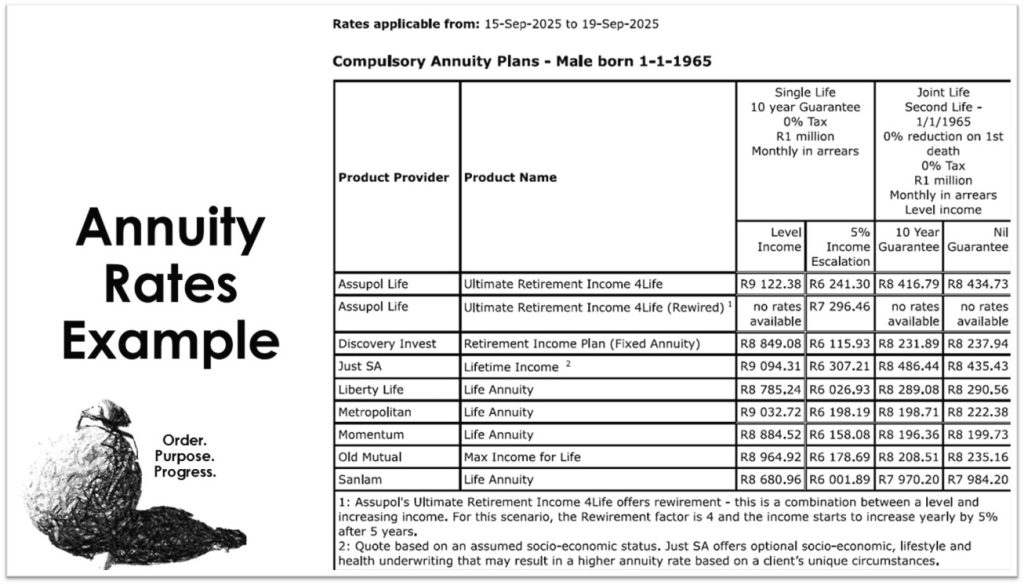
You can check the annuity rates weekly from a broad list of providers as below:

This table shows the rates for a 60 year old male, single life or joint Life (includes Spouse at 100% income). It shows a level income (does not change over time) and one that goes up by 5% a year. You can get a minimum guarantee period or not.

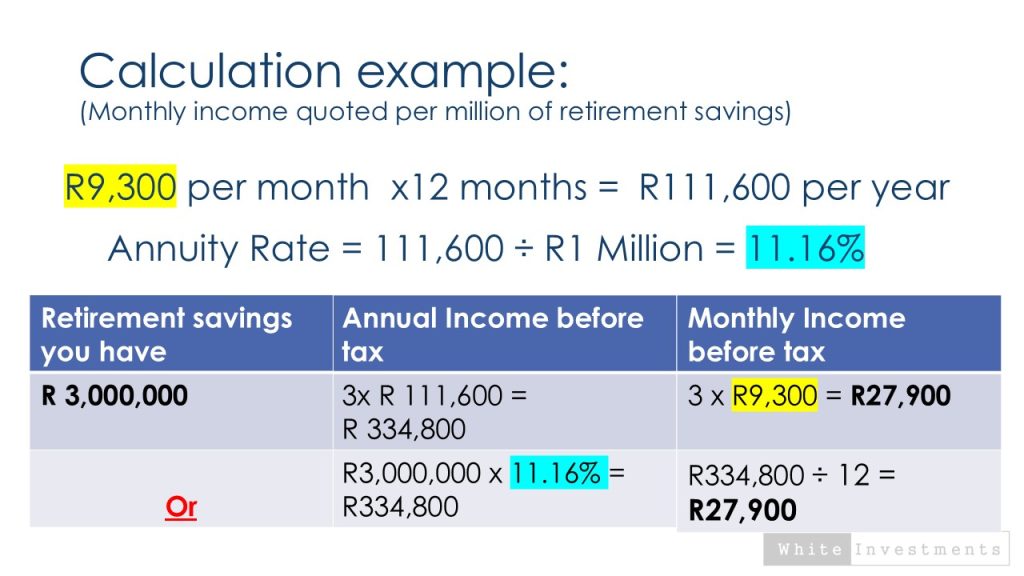
You would choose an annuity that best suits your own needs and use the corresponding Rand value to indicate the monthly income you will receive per R1 million that you exchange for it. 

Here is an example from my Retire Ready Workshop:

Using this calculation method at your chosen Rand annuity amount, will give you an idea of how much income you can expect.

This could then be compared to your current income to see what proportion of your current income your retirement income will cover.

This is called your Net Replacement Ratio.

What to keep in mind when considering Guaranteed or Life annuities

The terms are set for life they cannot be changed. 

Your income ends with you (or spouse if joint life). 

Nothing passes on to other beneficiaries.

A higher starting level income is attractive. It will take about 7 years before it equals an escalating annuity that increases at 5% per year. Thereafter you will see a steady fall in how much you can purchase with the same level income.

Bottom Line

The right annuity for you needs to be more than just a quote  – It should be a well thought out decision based on your personal needs and understanding of the risks and trade-offs involved.

It is not the time to be rushing decisions or risk making costly mistakes.

Here to help if you need it. 

Retire Ready Workshop
Read More

Given the governments track-record it is no wonder the signing of the NHI bill has left many concerned. 

What we know so far:

– NHI will change nothing immediately.

– It is not clear exactly how it would work or how it would be funded.

– There will be legal challenges.

– And the general consensus is that it could take up to 30 years to implement fully. Whatever ‘fully’ means.

Bottom line is we will have to wait and see what the facts are but it is going to impact each of us one way or another. 

A major concern for retirees

A major concern is that government will fund this by abolishing the Medical Tax Credit (MTC) system. This will essentially increase tax paid for members of these schemes. Less take-home pay. 

If the new NHI did not provide replacement services, and this private cover had to remain in place, it would effectively increase the cost of this cover for the user. Less income for other things.

For those not familiar with their taxes, Medical Tax Credits (MTC) and Additional Medical Tax Credits (AMTC) reduce your tax payable by allowing a deduction.

THE MTC and AMTC includes a calculation which account for medial aid premiums and additional allowable medical expenses.

People older than 65yrs can deduct more than those younger than 65yrs. 

It is designed to give some relief to tax payers who essentially fund government (pay tax) but cannot get the healthcare through the existing system. 

Abolishing this tax benefit is therefore a legitimate concern.

How much would it potentially impact on your pension take home pay?

* Assumptions: Income R450,000. Of which pension is R415.500 and interest income is R34,500.  The calculation is for a single member and the monthly premium is R10,321. This is based on an actual scenario for a 75yr old, who with his current solution pays zero tax on this income including his MTC. Naturally, changing any of the assumptions on the amount of income, the sources of income or the  cost of medical aid would alter the figures above. 

I am not sure there are too many people in retirement who would be happy with a 14% reduction in the amount that lands in their bank account each month?

I guess those seeking to implement the NHI would argue that after NHI was implemented, you would not need to pay medical aid premiums. So if you were not to get the tax credit you would still be better off. 

This would require a massive vote of confidence in this government’s ability to run the healthcare system as well as the private sector. 

Caveat: This is not supposed to be alarmist. You cannot take action until you know the facts. But it is an incredibly important aspect of your financial planning, even more so as we age. It will be a feature we need to account for in the years ahead. 

Read More
There are many good reasons to consider the DIY route for your financial life. So much in the financial services industry is frankly rubbish. Some is driven by product pushers. Some by genuinely fraudulent criminal elements. But there is no escaping that some is driven by the regulatory environment itself.

Regulations make DIY more appealing

Personally, I don’t think regulators fully grasp what it is like to sit down with someone going through a massive life transition, worrying about their finances and looking for some help. The amount of stuff we (FSP’s) have to do, to be compliant with the regulations, adds cost (time, effort, frustration & anxiety) to both the advisor and the consumer. This cost does not match the benefit in my opinion. The regulator probably thinks it is protecting people and in some extreme cases it probably is. However, the regulator only has jurisdiction over registered financial service providers. If you intend to conduct illegal activities , you definitely would not register as a financial service provider, thereby falling outside of the regulators scope. It usually takes the regulator years if not decades to actually action anything once they find a perpetrator. Far too little too late for the consumer in most cases. The irony is that regulations are failing the consumer even if you exclude the criminal element. The guys getting fleeced by rubbish products, sold mostly by the large insurance linked companies, are still getting fleeced. They are just getting fleeced within the guidelines and they have no recourse.

DIY as a solution

One popular solution to all of this is to go the DIY route. For those that have gone down this path, you will know it can be hugely time consuming when done properly. This stuff can get pretty complicated and the costs of getting it wrong are high. There is so much information out there, much of which is written with an agenda or bias. It is difficult to know who to believe.

There is an alternative.

Finding the middle ground between the full advice service and knowing what you have to do is possible. Like the retirement workshop I run – Your Retirement Questions Answered. No product specific advice. Just the facts. So there is no need to fill out all the paperwork and deep-dive into your finances. It is an hour long interactive workshop which arms retirees with the foundation knowledge they need when considering their retirement options. It fills the gap between Advice and DIY. You should check it out – it may be all the ‘help’ you need. Reach out if you have any questions on the above or if you would like help making progress in your financial life. Email Dominic Follow White Investments Facebook Page for insights, motivation and sometimes a bit of fun. This article first appeared in White Investments monthly newsletter. Sign up at the bottom of this page or check out past editions here.
Read More

These are indeed strange times – I have not really managed to get my head around all the different aspects and consequences of this pandemic. Like many I guess I’m gyrating between the “this too will pass” camp……..and the “if a clown invited me into the woods right now, I would probably just go” camp…..

I thought I would share a little nugget that I have observed in the weeks since the historical event of end March 2020 which began with the now infamous words….. My Fellow South African’s, Good evening…..

In my efforts to help people manage their money in a way that allows them to achieve their goals in life, I try to emphasise the importance of getting the basics right. And right at the top of the list of getting our personal finance basics right you will find the following concepts:

  1. Spend less than you earn – The dreaded B-word.
  2. Plan – think forward, define objectives and have a strategy.
  3. Resources are limited – choices must be prioritised.
  4. Opportunity cost – your decisions have consequences.
  5. Delayed gratification – the benefit of not consuming now.
  6. Be flexible – your plan will deviate and you must adjust.
  7. Behaviour & discipline significantly impact on your outcome.

For many of us the concepts listed above, while crucial, remain rather elusive on a consistent basis.

Then the world as we knew it changed. LOCKDOWN! And with it a ban on alcohol sales.

Behold! Many of us that had previously struggled to master even a quarter of the concepts listed above were immediately galvanised into action. Never before in my professional career have I witnessed such a widespread mobilisation of effort with one single objective in mind – having enough alcohol to survive lockdown!

The looming three week lockdown period witnessed a massive surge in the collective population engaging in the very planning process which seemed to have evaded their ability previously.

Collectively mothers, granny’s, sisters, brothers, uncles, aunts, friends, colleagues and mere acquaintances went into planning mode as if their very lives depended on it.

Overnight we could calculate how much beer, wine and spirits were required to ‘survive’ this period. Not just a thumb-suck, “I hope this will be enough” number. We are talking average consumption rates per day calculations which could put actuarial drawdown models to shame.

Furthermore, we were able to prioritise which drinks we wanted most of, and then as shelves emptied, we learned to settle for a back up in terms of brands or estates which could see us through to the end if required. Maybe not the first choice but we managed to see the sense in compromising the less than perfect options rather than run out altogether.

Many even went as far as to delve into the murky probability-based world of scenario planning. We had to allow for the chance that lockdown would not only last 3 weeks, or that consumption rates could feasibly increase and so we built in a contingency ….. lets call it an emergency stash….

The behaviour and discipline on display in delaying the gratification to ensure we still had some stock left after many weeks is nothing short of a marvel.

Then as is always the case, reality deviated from the plan. The lockdown was extended to 5 weeks and then into level 4, with alcohol sales still prohibited.

People refused en masse to take this lying down and they learned to adapt…. Innovation and a never say die attitude gave way to a plethora of home brewing recipes which saw pineapple prices quadruple and instant yeast stocks run out.

R45 bottles of wine have been changing hands at R300 and a bottle of Klippies selling for R1000 illustrated simultaneously the impact of inflation and compounding (albeit of desperation-levels), the laws of supply & demand and possibly even insight into the irrationality that causes bubbles…. The potential parallels are endless. 

In conclusion I would like to call Bulldust on people’s inability to plan, to show innovation, to be disciplined, to allocate scarce resources and to adjust to changing circumstances. 

That’s it people! No more excuses! Your retirement planning process from the build up phase “how much is enough?”, all the way into the consumption phase and draw-down in retirement is just the same.

You have just proven you have the skills needed to make a success of it, now find the motivation!

Read More

Let’s change the ending…

You may not have the power to change where you are but you can change where you are going.