Is your money doing a good job for you?

How do you tell?

What do you use to measure the progress you are making in your financial life?
The three-part framework that I use to support you in making the most of your finances, provides some good perspective: ORDER, PURPOSE, PROGRESS.

Investment Strategy Management (PROGRESS):

If you want to measure how well your fund manager is doing the job you employed her to do, you look at a benchmark.

For example, if you asked her to manage a portfolio of global shares, you can go check the factsheet of the MSCI World Index ETF. This is an Exchange Traded Fund (ETF) that tracks the worlds developed stock markets.

It will give you an idea of how she is doing on a comparative basis.

So far so good. But there are a couple of issues that you note will soon crop up.

1. Most portfolios are multi-asset in nature.

This means they invest in equities, bonds, cash, property and probably some kind of alternative (gold, crypto, Private Equity). Then you have offshore versus local assets, which introduces currency risk.

It becomes less easy to pick a benchmark that captures performance that is comparatively measurable.

One solution is to look at a ‘peer-group’. This is made up of a bunch of funds which have a broadly similar investment opportunity set.

The peer-group will let you know how the fund you own performed relative to other options you could have chosen at the same time.

Kind of like an opportunity cost consideration.

2. Cashflows change things.

A factsheet showing the fund performance conveniently ignores cashflows.

In reality you probably invest money on an ongoing basis, rather than as a single lumpsum.

The impact on performance is significant.

Example: You invest $1 a month for a year. Only 1$ out of the $12 is invested for 12 months. The last $1 was actually only invested for 1 month. If markets were going up over the year, your own performance is going to be lower than the fund factsheet. (Each month you paid more for your investment than at the start of the year). If markets were going down, you bought each month at a lower price and your performance should look better.

Your investment statement, from your platform or admin provider, should reflect your performance including the impact of when you invest or take out money from your account. We call these your cashflows.

In this context, it makes sense to look at your statement and measure it relative to what your planning process revealed as a required return target.

Financial Planning Perspective (PURPOSE):

Any goal you have will have a future target value, a time horizon and an amount you can contribute towards it.

From this you can calculate a required RETURN TARGET that will get you to your goal.

In theory, you would then build a portfolio of investments to target that return requirement with as little chance of failure as possible.

Something like, I need 12% after fees to turn my current R100 into the R1000 I need in 20 years time. How am I doing?

This works to make it more meaningful to your actual purpose.

But markets tend not to work in straight lines.

A 12% return after fees may actually include periods of gains much bigger than 12% with the occasional negative year thrown in.

It can be difficult to know where you are at any single point in time.

As we all know market returns are not in our control.

It could therefore be helpful to measure something that is more in our control. Like our contributions.

The contributions you are able to make are impacted most by our personal finances.

Personal Finance Perspective (ORDER):

How you manage your personal finances determines your ability to meet your required contribution rate (assumed in the planning process).

At least this involves managing stuff that is more in your control.

How you use debt. What your living expenses are. How much you have available as disposable income.

If you are not putting away the money you thought you could, it is highly unlikely your overall plan, based on those contributions, is on track.

If the planning assumptions are not right then there is a good chance your investment strategy is not appropriate either.

What is the point

The point is your success is dependent on getting all three areas right.

ORDER=>PURPOSE=>PROGRESS=>

Measuring your progress in a way that captures all of these elements makes sense. It is a good idea to look at different metrics that are appropriate for each.

We may like to think managing money is a science but there is a lot more art to it than meets the eye.

#orderpurposeprogress

Read More

Money management is full of trade-offs.

You usually have to give up something to gain something. This is required in your personal finances, financial planning and even investment strategy.

Finding the balance for what works for you is crucial.

1. The trade-off between rational and reasonable:

When fine tuning your personal finances (CREATING ORDER), it might not be rational to spend R3,000 on shoes this month, but it might be reasonable.

The rational spreadsheet would certainly not include that line item.

But if it allows you to stay committed to the greater spending plan in the months ahead (and have something left over to invest), then perhaps it is reasonable.

Feeling like you are unable to live life in the present often leads to a plan being abandoned all together.

Rather make reasonable decisions and progress.

2. The trade-off between flexibility and returns.

A good example of a trade off in financial planning (HAVE PURPOSE) is illustrated in the tax planning element.

You want to pay less tax? Of course you do. It increases your returns or what you get to keep.

Well then you are going to have to put your money into accounts which gives you some tax relief. Such as Retirement Savings accounts.

But you lose some access to your money when you save in a retirement fund*. In an Retirement Annuity, for example, you can only access funds at age 55.

And when you access your funds, you have to use two-thirds of the money to buy an annuity income of some sort (Life or Living).

You have less flexibility around your choices but you did get to grow your funds without paying tax.

AND you could contribute to retirement funds before paying tax. This is definitely a worthwhile boost upfront.

3. The trade-off between certainty and returns.


When structuring an investment solution (MAKE PROGRESS) we typically want high returns with little to no downside.

But the real world does not work that way.

The mix of assets we have available to invest in have different characteristics. This means they respond differently to each other during the investment cycle and have different jobs to do for you. 

‘Income assets’, like bonds and cash, give you more certainty about your returns. But the price of the certainty is lower returns.

Whereas ‘growth assets’, like shares and property, provide less certainty about your returns short-term. However, over the long-term you probably grow your money much faster.

Your investment mix (asset allocation) is therefore a trade-off between certainty required and returns required.

Each objective you have, will have a required return and a level of certainty required, depending on your time horizon.

*If you want to understand your options and trade offs when it comes time for you to start accessing or consuming your savings (your annuity options are all about trade-offs too) you should join for a workshop. I have set up an interactive workshop to help those approaching this critical time of their lives with the foundation knowledge they need to make the tough trade off decisions – You can find out more at YOUR RETIREMENT QUESTIONS ANSWERED. 

Read More
There are many good reasons to consider the DIY route for your financial life. So much in the financial services industry is frankly rubbish. Some is driven by product pushers. Some by genuinely fraudulent criminal elements. But there is no escaping that some is driven by the regulatory environment itself.

Regulations make DIY more appealing

Personally, I don’t think regulators fully grasp what it is like to sit down with someone going through a massive life transition, worrying about their finances and looking for some help. The amount of stuff we (FSP’s) have to do, to be compliant with the regulations, adds cost (time, effort, frustration & anxiety) to both the advisor and the consumer. This cost does not match the benefit in my opinion. The regulator probably thinks it is protecting people and in some extreme cases it probably is. However, the regulator only has jurisdiction over registered financial service providers. If you intend to conduct illegal activities , you definitely would not register as a financial service provider, thereby falling outside of the regulators scope. It usually takes the regulator years if not decades to actually action anything once they find a perpetrator. Far too little too late for the consumer in most cases. The irony is that regulations are failing the consumer even if you exclude the criminal element. The guys getting fleeced by rubbish products, sold mostly by the large insurance linked companies, are still getting fleeced. They are just getting fleeced within the guidelines and they have no recourse.

DIY as a solution

One popular solution to all of this is to go the DIY route. For those that have gone down this path, you will know it can be hugely time consuming when done properly. This stuff can get pretty complicated and the costs of getting it wrong are high. There is so much information out there, much of which is written with an agenda or bias. It is difficult to know who to believe.

There is an alternative.

Finding the middle ground between the full advice service and knowing what you have to do is possible. Like the retirement workshop I run – Your Retirement Questions Answered. No product specific advice. Just the facts. So there is no need to fill out all the paperwork and deep-dive into your finances. It is an hour long interactive workshop which arms retirees with the foundation knowledge they need when considering their retirement options. It fills the gap between Advice and DIY. You should check it out – it may be all the ‘help’ you need. Reach out if you have any questions on the above or if you would like help making progress in your financial life. Email Dominic Follow White Investments Facebook Page for insights, motivation and sometimes a bit of fun. This article first appeared in White Investments monthly newsletter. Sign up at the bottom of this page or check out past editions here.
Read More

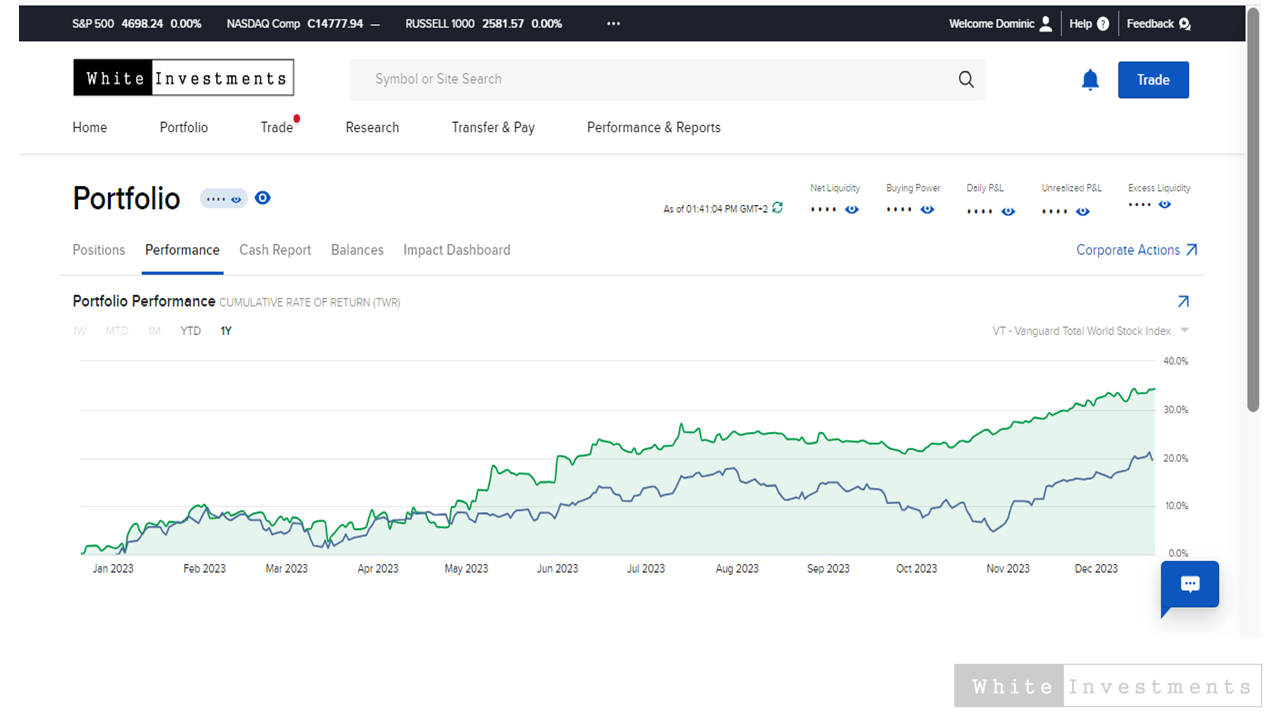
Top Investment Performer – Anyone can generate a one-year return which looks amazing. Understanding how it was achieved and for what purpose is even more important. Context is important.

This is a screenshot showing an actual return from a portfolio I manage on my offshore platform of choice.

The GREEN line shows the portfolio performance and the BLUE line returns from a Global Stock Index. 

Looks pretty good right?

Should be used in some kind of marketing strategy right?

But do you know what it does not tell you?

  • How much risk was taken to achieve this return. And by risk I don’t mean volatility or how values fluctuated through the year. I mean the opportunity for a permanent loss of capital.
  • What was the performance of this portfolio for the 5 years before 2023? If it was -80%, then these returns are still some way off of delivering any value.
  • What was the objective of the portfolio? If this was a safe ‘I potentially need to spend the money in the next 12 months’ type portfolio, was this investment strategy appropriate?
  • How much of this persons overall wealth does this portfolio represent?  If this is their fool-around-money then it changes the perspective entirely. It is easy to take big risks and earn big returns when there is nothing really at stake. 

When you are reviewing your returns, it is important to make sure you put them in context.

This is not about chasing the highest returns.

You are playing your own game.

You invest with your PURPOSE in mind and measure your results on that.

Read more about how to consider context in your money management: HOW WELL IS YOUR MONEY DOING?

Or if you want some support to set up and invest a portfolio directly offshore? Let’s chat.

Read More

Hindsight makes diversification look unnecessary.

This is such an insightful quote by Joe Wiggins (read the full article here) .

When you look back on past returns it is easy to convince yourself that it was obvious what you should have been doing.

That you could have captured the best performance available. This will probably make you feel frustrated. 

But getting frustrated is a disservice to yourself and your emotional well-being. 

Here I offer some examples, using the broad asset classes (things you can invest in) for South Africa.

Each graphic shows you what investing R100 in each asset class would have delivered for that specific time period. (For simplicity sake it ignores fees, taxes and assumes no additional cashflows).

Looking back 18-years

Over a long time period (18 years above), you can see that SA equity (share or stock market) turned R100 into R835. That is an average annual return of 12.5%. 

In Hindsight you just load up on as much SA equity as you can and sit back and enjoy. 

SA Property was an even better performer, right up until the end of 2017 when things took a sharp turn for the worse. But over the full 18 year period you were still much better off in Property than in SA Bonds or Cash.

Note how boring and safe SA Cash is – the line is just a very gradual but steady grind higher, turning your R100 into R339.

Inflation (CPI – consumer price inflation) in SA averaged about 5.5% over this period so for your R100 to still buy you what it used to buy you, it would need to be worth R262. In simple terms anything above that has improved your purchasing power or real wealth. 

Looking back 10-years

Shrinking our time horizon to the last 10 years and you can see that owning property may have started out nicely, but then collapsed in the pandemic, to deliver heavy losses. And over the 10 year period you would have pretty been static (R100 becomes R119).

SA Equity is still the best performer overall but it too returned less than cash (in 2020) as a result of losses during the pandemic shutdown.

SA Bonds and Cash tick along in a more predictable way, minus the opportunity for either very good or very poor returns. 

Looking back 5-years

Shrinking our time horizon further, to the last 5 years, and Hindsight will tell you it was obvious not to have had anything invested in SA Property at all. 

But now maybe Hindsight is feeling a little schizophrenic – Was it a good idea to be owning SA Equity or not? In fact as at the end of October 2023 SA equity has delivered marginally less than SA bonds over the 5 years.

What if you had started this period 5 years from retirement? How would you be feeling now?

If you owned SA Equity, how would you have felt underperforming SA Cash and Bonds for the first two years? Would you have held onto the position?

How about SA Property which turned your R100 into R79 by the time you reached retirement – surely that would have been a sell?

Looking back 3-years

Finally, over the last 3-years order is restored to the universe. SA Equity and Property are the clear winners. You have been rewarded for taking on the extra risk.

And of course Hindsight would have helped us to capture the rebound in property stocks with perfect timing. 

Looking back 12-months

And what about over the last 12 months?

SA cash has been the investment of choice in Hindsight.

If two investments start with R100 and end with R108, the one that has done this with the least gyration (volatility) is the preferable investment.

Both technically and emotionally.

What you can take away from this

– Without the benefit of hindsight it is impossible to know what returns the market will deliver with certainty. 
– You can however make some inferences based on current yields for cash and bonds, or valuations for Equity and Property investments.
– Over very long time horizons it is a good idea to own some Equity and Property.
– For very short time horizons, you should probably own neither Property nor Equity.
– Having an appropriately diversified portfolio for your time horizon is the right thing to do. But it will always feel a little like you are missing out.


Reach out if you have any questions on the above or if you would like help making progress in your financial life.

Email Dominic

Follow White Investments Facebook Page for insights, motivation and sometimes a bit of fun.

This article first appeared in White Investments monthly newsletter. Sign up at the bottom of this page or check out past editions here.

A flat fee advice service is a great way to access quality help for a pre-agreed upfront cost. 

The purpose behind my service is that it works to make you better off. And for that you will be charged a fee. Which ideally makes me and my family better off.

It should be a neat and tidy relationship to have, as long as you feel you’re getting good value and I feel like I am being fairly compensated.

But the funny thing about this profession is that there’s a lot of grey areas. Even the best laid plans can take time to work. And the best laid plans might not look like the best laid plans at times.

So we can land up undulating between feeling good about things….and well…..not.

Fee based advice

I  have a fee structure that allows you to choose what you value and how you pay for it:

– Factual information devoid of any advice on your specific situation can be accessed during an hourly consult. DIY heaven right?

– Working to put a solution together that meets your specific needs can be done for a once-off fee agreed upfront.

– And if the input you require is ongoing then an additional monthly fee or retainer will be charged.

See more on service options here.

Transparency is key

I would like to help you understand the cost and value proposition so you can make the decision that suits you best.

I accept that not everyone will see value in my service. It is important for both parties to ascertain this as early as possible.

I therefore encourage you to use the f-word as early and as often as you need in our relationship!

Read more of my thoughts about fees…. 

How much advice costs
Read More

Common sense can be one of the first casualties when faced with a crisis. But common sense investing is the same in a crisis as absent a crisis.

It has been another interesting period as far as markets are concerned. Bank failures have been all the rage in financial media.

Even though I find lots of this stuff interesting, I don’t typically send out communications about such things.

Good reasons not to share market news:

  1. I cannot add any value to the copious amounts of analysis already being generated.
  2. By the time you read it (if you do) its old news anyway.
  3. It encourages noise and a short-term focus in a process in which I work hard at trying to eliminate those things.
  4. I don’t change portfolio’s or investment strategies based on market news but valuations or changes in your objectives.
  5. I don’t want you worrying about things you have no control over.
  6. Is it still going to matter in 12 months time? Probably not.

Is the new banking crisis contained or not? Is there more to come?

I don’t know

Honest answer – I don’t know. When I managed large credit funds in 2007/2008 there were many really smart people saying that the financial crisis was contained. That was clearly false.

What I learned back then is that is not what everyone is cleverly writing about that should worry you.

It is the stuff that they are not writing about that is going to bite you. And that is because that stuff is simply not knowable.

It is not knowable because every action has consequences. Thinking that we can control a complex system has never proven to be true. You fix one thing and break another. 

Combine Investment and planning skills

In  my opinion that is why combining both investment skills with planning skills brings the two worlds together in a way that is meaningful for your success.

Ensuring your investments align with your planned objectives (what is important to you) makes it easier to keep your strategy focused on your successful outcomes, even when the short-term noise is thunderous.

So what to do

Simple actions that actually work include staying well diversified – that means because you don’t know for certain, you don’t build a portfolio or a plan as if you do. 

It can be helpful to have some money to put to work if things cheapen up, have some money invested in case they don’t.

You won’t be the best performer this year. You won’t be the worst performer either. But you will survive to see your plan through to fruition.

I thought this was the best article I read regarding the SVB failure – *HINT* it has little to do with SVB and I challenge you not to take something useful out of it.

Read More

I have a spare 2 million, what do I do with it?

A question that comes up in various forms more often than you may think. First world problems perhaps, but problems nonetheless.

Since one-size-fits-all solutions don’t exist (unless you are being sold a product), answering the question requires some context.

3 Broad Categories

  1. You don’t need the money now or in the future.
  2. You are not sure if you are going to need it in the future or not.
  3. You are going to need it in the future.

Don’t need it

That’s great. Now to decide how to use it in a way that will add the most value to your life.

  • Fulfil a bucket list item – travel, experiences.
  • Donate it – fund a charity or good cause. Sustainably preferably. You can give up to 10% of your income away to PBO a year and deduct from taxable income. A well structured portfolio may allow you to do this on an ongoing basis rather than a once off lumpsum.
  • Help a family member. Setting up a retirement account for the grandkids could be an incredible way to change their lives. It keeps the money focused on the long-term as they can’t access it until later in life.
  • Maybe a combination of all the above.

Not sure if I will need it

There is some planning required from your side. Some questions to ask that may help you in this regard:

  • How does this money fit into the rest of your finances?
  • Are there any gaps you need to fill? (Estate Liquidity, more comprehensive medical cover)
  • What do you need to live off now and in the future?
  • How much is enough to comfortably secure that?
  • Build  in a safety net because life happens.
  • What do you have left? See 1 above.

I will need it in the future

Refer to planning in 2 above if you are not confident in how you can make the most of this money. Leaving it in the bank for an extended period of time is not likely to serve your best interests.

  • Do you need it to supplement your income?
  • Or are you trying to the preserve the purchasing power of the capital?
  • When will you likely need to use the funds? Time horizon.
  • What are your expected uses or cashflow requirements?
  • What are your biggest concerns about putting this money to work if any? Losing  money or losing access to the money?
  • Have you thought about later life care, estate planning and liquidity?
  • What taxes are you likely to be paying?

Importance of Context

This sort of context allows you to construct a solution that not only answers the question of what to do with the money but it also ensures you put it to work in the most meaningful way for yourself. 

Read More

How to pick the best investment fund is a priority for many people. For some advisors this is their main selling point.

Apparently, the African Wild Dog has a hunting success rate of 80%. They eat 8 out of every 10 times they put in the effort to hunt. That is an impressive track record.

The lion on the other hand is thought to enjoy only around a 20% success rate.

When trying to pick top-performing funds we like to believe we are wild dogs. In reality we are more like lions. Old lions. Solitary old lions.

Past performance

This is mostly because we tend to rely on past performance. The industry likes to publish fund awards and some people use this as a selection tool.

But these techniques do not serve us well. Statistically, the winner of the best performing fund over 3 years or even 5, is very unlikely to hold that position over a similar period going forward.

This is because funds that perform well over these periods, either have higher volatility (they use more risk), or they have a particular investment style which has just been through a market cycle that suits that style.

Some cautionary truths about investment returns 

• Returns tell you where you have been not where you are going. Hindsight is 20/20.

• They tell you nothing about the risk taken to achieve them. Downside.

• Returns don’t tell you if they were achieved via skill or luck. Repeatable.

• They are not linked to your objective. Were the investments appropriate to your goal?

• They don’t tell you anything about current market valuations.

• Often a very strong performance from a fund, asset class or investment is followed by a period of weakness. The cure for high prices is high prices.

• Returns can be used to tell a good story simply changing the time horizon of the analysis.

Better ways to pick investments

The biggest determinant of your future returns is the price you pay for the investment. 

What are you trying to achieve. What returns do you need to get there. Based on current valuations, is this investment likely to deliver on those returns. 


My relationship with money is complex. Yours probably is too. Maybe not for the exact same reasons as mine but you are human too.

It makes the answer to the above question far more difficult than it appears at face value to me.

If I were to frame it as ‘Would I rather make R100,000 or R150,000?’, the answer is quite simple.

But as soon as I make it comparable to everyone else, things get complicated.

To be honest I don’t have a reference for the research where this question was tabled but apparently most people (whoever they are) opt for OPTION A.

Yes that’s right. On average people would opt to earn less money as long as they earned more than everyone else. All else equal.

And the all else equal part is important because it means we can all consume the same things, at the same price and get the same use from money as everyone else.

But in reality, we don’t know what any of the values mean in terms of what lifestyle we could afford at each level. Does it meet our basic requirements or does it allow us to live the life of our dreams? The answer is clearly different for each person.

We don’t all want the same things in life. Some prefer a nicer car or house and others may choose more free time. Some get to do both. But what constitutes a nicer car or house is also open for debate.

But all else equal it is still a question worth contemplating.

In my mind:

OPTION A:

  • Is a framework where we are making decisions based on comparing ourselves to others.
  • I don’t want to feel poorer than other people. I want to be richer than other people.
  • I think more money means nicer things which means more happiness.
  • It supports the view that money management is as much about emotions as it is about numbers.

OPTION B:

  • Clearly has more of a focus on my own journey.
  • What do I need to live a life that I feel is worthwhile.
  • There really are things in life that money can’t buy.
  • What do I need to give up (time, peace of mind, health) in pursuit of more money.

WHAT IS THE RIGHT ANSWER?

I am not here to say which is better. I do think it is a question worth contemplating though.

On that note here is an article worth reading for more concepts that are very important and hard to teach.

You can also see how to perhaps think about framing your investment approach to the life goals you have here.

Read More

Let’s change the ending…

You may not have the power to change where you are but you can change where you are going.